Games with rules are games in which players agree how to play: whose turn it is, what each player can do and when the game ends. They include board games, playground games and simple games you invent together.
For a preschooler, start with one clear rule and a short game. You can practise stopping, waiting or taking turns without needing a complicated board or a winner.
Jump to: Three simple games · When rules are tricky
Games with rules are one of the four types of play discussed in the work of developmental psychologist Sara Smilansky. Explore the other types here:
What are games with rules?
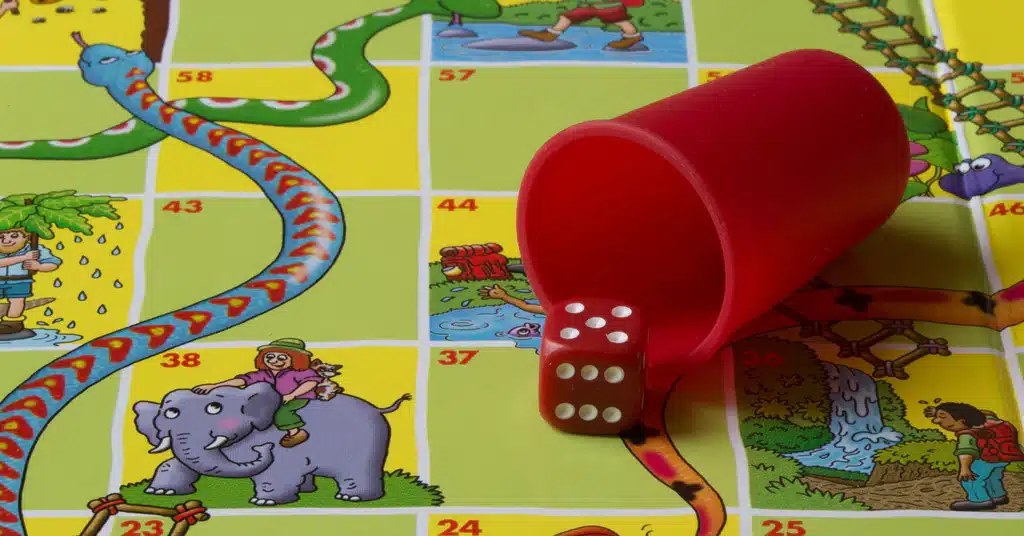
When you think of games with rules, what comes to mind? Cricket? Snakes and Ladders? These games have codified rules: they are written down. There’s no room for argument (unless you’re one of my children, in which case the rules are apparently just guidelines…).
But what about playground games like tag and hopscotch? There’s no rulebook, but we all know how to play.
There’s another type of rules-based play – situational. In this kind of game the players agree the rules amongst themselves. They can be completely arbitrary so long as they are accepted by everyone. “You are the baby and I am the big sister. Let’s play ‘bedtime’. I wrap you up and you lie in the bed’. No, you’re not allowed to get your own blanket. I have to do it. Babies can’t walk”
Why are they important?
I grew up in the ’80s so my taste in music is questionable. There’s a song by Bruce Hornsby called ‘The Old Playground’ which has the line “Everybody knows how you play is who you are.”
Games give us something concrete to talk about: what is fair, how we take turns and what happens when we disagree. A difficult round can become a chance to practise together.
Who makes the rules? Can we change them? What happens when someone forgets? A young child may know it is someone else’s turn and still find waiting difficult. Agreeing a simple rule, modelling it and offering a reminder gives her a way to join in.
Games also offer practice in keeping a rule in mind, paying attention and pausing before acting. More complex games invite higher order thinking: choosing a move, considering alternatives or anticipating another player’s response. Choose a challenge your child can enjoy with some support.
How can I encourage games with rules?
If your home is anything like mine, it’s not always easy. Having children close in age can mean several players who all want the next turn. Keeping the rules simple gives everyone less to remember while they practise playing together.
That’s one of the reasons board games are hard to play with a three-year-old.
What has worked for us in the 100 Toys house is co-operative games like those by Peaceable Kingdom. The players work towards a shared goal. In Race to the Treasure, for example, you win or lose as a team rather than having one child beat another. The manufacturer lists it for ages five and up; the simpler games below offer a starting point without a boxed game.
Start with a short game, demonstrate the rule and play a practice round together. Taking turns and handling disappointment take practice; you can work on one small part at a time.
You won’t get all of this from a preschooler. It’s a long road, but you’ll get there in the end.
Three simple games with rules to try
Choose one of these invitations. Explain the rule by showing it, then let your child have a go. Stop or simplify the game if it becomes frustrating.
1. Musical statues (freeze dance)
The rule: Move while the music plays; stop when it pauses. You can clap instead of using music. Play alongside your child at first, and start moving together again after a short pause. Nobody needs to be “out”.
2. Roll the ball
The rule: Take turns rolling a soft ball to each other. Sit facing one another and say, “My turn to roll, then your turn.” Keep the wait short. When that feels familiar, invite another player to join.
3. Build a shared tower
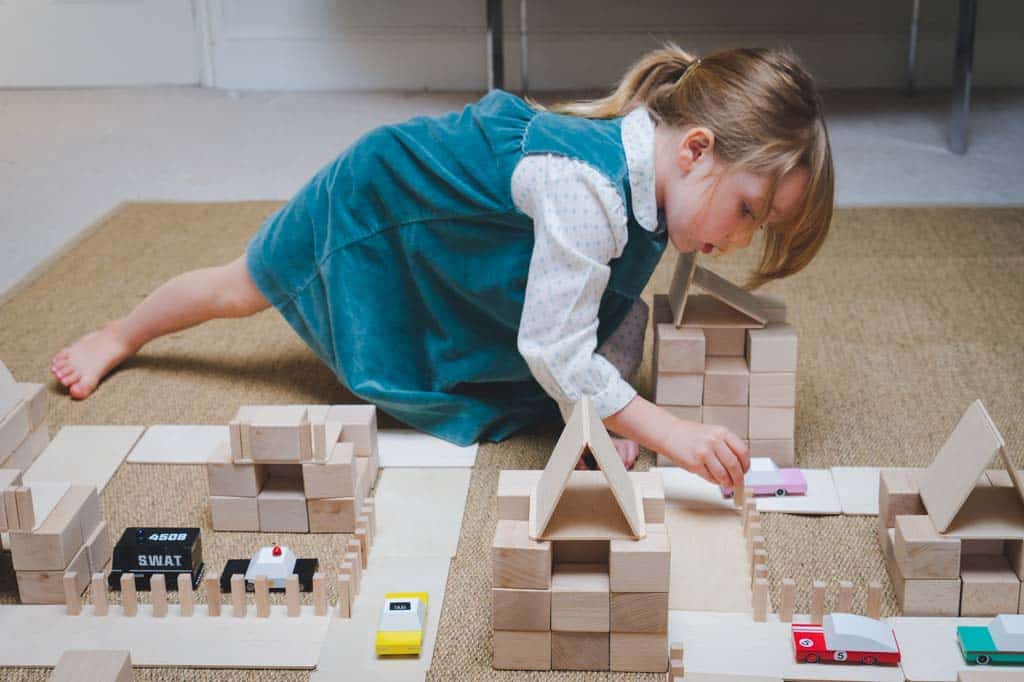
The rule: Each person adds one block on their turn. Use blocks your child can handle easily and build on the floor. If the tower falls, start again together. You are making something jointly, rather than competing to build the tallest tower.
What if my child changes the rules or gets upset?
Bring the game back to one agreement: “In this round, we each add one block.” You can try your child’s new rule in the next round, as long as everyone agrees. Remind her whose turn comes next, or demonstrate the rule again.
If waiting or losing feels too hard, acknowledge the feeling and make the next round shorter or easier. You might say, “You wanted another turn. It’s my turn, then yours.” It is fine to pause or finish for now. The aim is a game your child wants to return to.
Would you like more ideas for learning through play? Our free Guide to Preschoolers is a useful next step for exploring play and development at home.
Further reading: Harvard’s activities guide includes play ideas for practising attention, memory and self-control. The manufacturer’s Race to the Treasure instructions explain its co-operative goal and recommended age.
Are you ready for school?
Do you have a preschooler? Would you like them to develop some key skills before starting school? How wonderful to go into school on that first day feeling like you belong.
Get Set Five is a year-long course full of fun and free activities to do with your child.